Archive for August, 2008
Anchor Bolt Source: Seemingly Simple
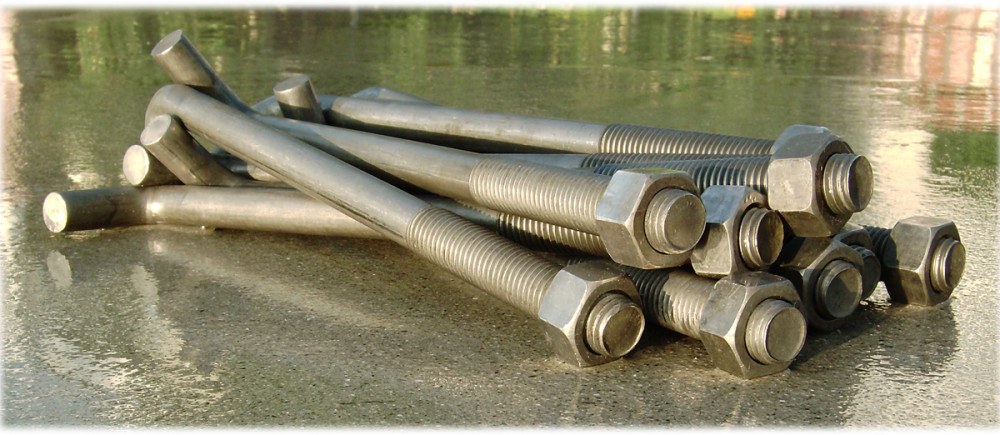
August 26, 2008 7:14 amAnchor bolts, although seemingly simple in appearance, are actually quite complex construction pieces. At first glance you wouldn’t think much of an anchor bolt, its style and design seem uncomplicated and there isn’t much you could think to do with the anchor bolt right off the top of your head. This is the biggest misconception about anchor bolts that there are.
Even though the anchor bolt looks simple in design, there is a rather detailed process that each goes through in order to become an anchor bolt. This process can be found within this resources section in four separate parts (Part I, Part II, Part III, and Part IV).
Not only is the process of manufacturing anchor bolts a bit complex, but the installation and use of these anchor bolts is just as equally intricate as their creation. There are so many different applications that anchor bolts can be used in, and although their basic intention is the same, there are many ways to install these devices.
Safety also comes into mind. Not only is the installation process somewhat lengthy, you also have to be worried about properly installing these pieces so that they remain where they are and therefore are safely installed.
All of this together makes a seemingly simple anchor bolt into something much more advanced. We use these bolts everyday in many different structures and it is time that we recognized how important these bolts are to the entirety of our social civilization.
Anchor Bolt Source provides high-quality, nonstandard anchor bolts and construction fasteners. For more information please visit the Anchor Bolt Source website.
Categories: Information
No Comments »
Anchor Bolt Source: Glossary
7:11 amSometimes, it is hard to understand all the different terms that are used when talking about anchor bolts. There are quite a few words that may not have any meaning to the average person. Below is a list of a few words that may have confused you at first.
Anchor bolt - a long, usually L-shaped, bolt embedded in concrete or another strong material for the purpose of fastening to a foundation or other support.
Cut Threading - A process in which material is removed from the end of the bolt in order to create the threading.
Eye Bolt – A bolt that is made with threading on one end and a loop or ring on the other.
Hot Dip Galvanizing – The process of “dipping” fasteners in molten zinc in order to create a coating on the exterior of the bolt. This helps create a resistant coating, allowing the fastener to resist corrosion.
Plain –A fastener that is free from any coatings (such as zinc).
Roll Thread – A process in which the fastener’s threading is made by displacing material using dies. The fastener is created with a reduced diameter in order to compensate for the threading.
Hopefully, these few terms start you on your way to understanding anchor bolts a little bit more than you did before. There are a massive amount of terms that have to do with anchor bolts, but if you start getting into the business, these terms will come to you naturally. The few terms above are just a few to get you started on your way to learning more about anchor bolts.
Anchor Bolt Source provides high-quality, nonstandard anchor bolts and construction fasteners. For more information please visit the Anchor Bolt Source website.
Categories: Information
No Comments »
Along with the multitude of customizations that can be done on anchor bolts during the manufacturing process. There are a few items that can be performed on anchor bolts in order to make them suitable for certain applications.
Stamping – In some situations, the manufacturer’s logo must be stamped onto the anchor bolt in order to properly identify it.
Swedging – This is where indentations are placed along the anchor bolt (on the unthreaded portion). These bolts are commonly used in highway work.
Chamfering – Done to anchor bolts in order to make it easier for a nut to be installed onto the threaded side. On the opposite spectrum, there is also a process to create a point on the unthreaded end of the anchor bolt. This is commonly used for wood installation and similar situations.
Custom Welding – In some cases, custom welding is needed in order to assemble certain custom anchor bolts.
These different applications all have their own reasons why they might be necessary. Most contractors will know if they need to have their bolts altered for any reason. Although, if you are interested in learning more about these different applications and more about the process you can get in touch with an anchor bolt manufacturer.
Anchor Bolt Source provides high-quality, nonstandard anchor bolts and construction fasteners. For more information please visit the Anchor Bolt Source website.
Categories: Information
No Comments »
Anchor bolts are used all over the world in many different projects. In order to find a good manufacturer take a look at their portfolio of projects that they have completed or have had their anchor bolts used in. This is the best way to find out if the manufacturer that you are looking at has had quality anchor bolts that have been used in a multitude of projects. A few of the different categories or projects that many anchor bolt manufacturers may be involved in are:
- Marine projects (boats, marinas, piers, harbors, etc.)
- Buildings (towers, hotels, casinos, airports, etc.)
- Railways
- Stadiums
- Power and Energy (windmills, power plants, transformers, etc.)
- Amusement Parks (roller coasters, steel and wooden)
- Bridges
- Industrial
- International
- Government Applications
These are, of course, broad categories of all the uses for anchor bolts but they do cover most of the subcategories that anchor bolts are used for.
Anchor Bolt Source provides high-quality, nonstandard anchor bolts and construction fasteners. For more information please visit the Anchor Bolt Source website.
Categories: Information
No Comments »
This is the last portion of the “Anchor Bolt Production” articles. It can be seen as the most important step as well as the least. This is because the step I am referring to is shipping. The shipping of your product is extremely important in the fact that the product needs to be on time and in good condition when it is received by the customer. If a manufacturer doesn’t have a great shipping policy then all the work that was done beforehand to create anchor bolts may have been in vain.
The shipping of anchor bolts comes in many different shapes and sizes, all depending on the size of the anchor bolts that the customer ordered ranging from small boxes to large palletized deliveries.
In order to keep a company or contractor as your customer one of the biggest concerns is time. All contractors are on a time limit and waiting for their supplies and materials is a big way to make them behind schedule. This is why contractors make sure that their anchor bolt manufacturers are on time and can always deliver a great product.
This being the last step in the process, the anchor bolts are on their way.
Anchor Bolt Source provides high-quality, nonstandard anchor bolts and construction fasteners. For more information please visit the Anchor Bolt Source website.
Categories: Information
No Comments »
This is the third installment of “Anchor Bolt Production”. In this edition we will talk about galvanizing (which is an optional part of the process. All anchor bolts are not galvanized, but everything galvanized is an anchor bolt. Wrap your mind around that one.) as well as the testing section of the process.
Galvanizing is where a bolt is dipped into a vat where it is then coated with molten zinc. The bolts are brought out and allowed to dry and solidify. The reasoning behind galvanizing is so that the steel or iron of the bolt is more resistant to corrosion. Zinc prevents corrosions by creating a physical barrier between the steel and air or liquids. Galvanizing the anchor bolts is completely up to the customer and what the intended use is for the completed bolt.
The testing process can vary between companies, although all testing labs and machines have to be accredited (which means inspection, testing, and certification of all machines) in accordance with standardized methods. In most cases the following is true: All bolts are tested for mechanical, hardness, and rotational capacity. The testing of anchor bolts is extremely important, especially in the terms of quality control. If an anchor bolt fails a customer, irrevocable damage could incur. This is why the testing portion of the process is so important.
Anchor Bolt Source provides high-quality, nonstandard anchor bolts and construction fasteners. For more information please visit the Anchor Bolt Source website.
Categories: Information
No Comments »
We started talking about producing anchor bolts and what it takes in order to mass-manufacture this type of construction material. In the last post we discovered the first two steps to creating anchor bolts. The first was cutting the stock material into the proper diameter and the second step was to thread the bolts using either a cutting or rolling technique. In this post we will discuss the third and fourth step to the process of manufacturing anchor bolts: heading and bending.
Heading is the process of creating the head of the anchor bolt. This process can be done before or after the threading process. During this step the end of the round bar is heated so that it can be forged into the head of the anchor bolt. Anchor bolt heads come in many different styles and shapes, all of which can be discussed with the manufacturing company that you use. Some of the most common ones used are hex, square, carriage, and guardrail. After the end of the round bar is heated an upsetter or a press is used to create the head. This is done by compressing the round bar while it is heated so that a head forms.
The bending process is actually the most self-explanatory step in the process. Anchor bolts can be bent into many different angles and some of the most common are U-bolts, J-bolts, I-bolts, hook bolts, and the most standard 90˚ anchor bolts. Anchor bolts are usually hot bent (meaning they are bent after being heated) this makes it easier for the material to be shaped into the different types that are needed.
With the next two steps down it is easy to see our anchor bolts starting to take form. So the question is, what is left in the process? What more could there be to do in order to compete our anchor bolts. The answer to these questions can be found in the next post in this edition.
Anchor Bolt Source provides high-quality, nonstandard anchor bolts and construction fasteners. For more information please visit the Anchor Bolt Source website.
Categories: Information
No Comments »
How are anchor bolts made? This is a common question that is asked by many people. Not only those that have a working relationship with this material, but also with those people who may just be wondering how these bolts are mass produced. This post and a few others will be dedicated to sharing with you, each part or the anchor bolt manufacturing process.
The first part of manufacturing anchor bolts is cutting the round bar material to the specified length needed. This can be done in two ways, with a band saw or a shear. The band saw uses a blade while the shearer uses a chopping motion. Both of these techniques are used in their own applications. For example, larger diameter anchor bolts are cut using a band saw because the diameter size is too large for a shearer to cut efficiently and properly.
The next step is to create the threading for the bolt; this can also be done in two ways: cutting and rolling. Cutting the thread for the anchor bolt means just that, cutting away the steel from the bolt so that the threading is made. The bolt used is a measured at the exact full diameter that it needs to be and the threading is cut into it. Rolling the threading is the opposite. The threading is “rolled” onto the cut bolts, which are cut to be smaller in diameter (either the whole length of the bolt or only the threaded portion) so that with the threading, the bolt will be the full diameter required.
These are only the first two steps in manufacturing anchor bolts. For more on the process of anchor bolt creation, please take a look at Part II of this post.
Anchor Bolt Source provides high-quality, nonstandard anchor bolts and construction fasteners. For more information please visit the Anchor Bolt Source website.
Categories: Information
1 Comment »
Anchor Bolt Source: Rock Bolts
6:31 amAs you’ve most likely already become aware, there are many different types of anchor bolts that are available for many different applications. The one that is going to be introduced today is one that is especially important to all of those people driving or traveling, the rock bolt.
Rock bolts are used in order to keep a tunnel or rock cut stable, so that they don’t cave in. A rock bolt transfers the load from the exterior to the interior of the rock mass. The exterior is weak and usually unstable, while the interior is strong and resilient. That’s right; a rock bolt is what is responsible for your life while you are driving through tunnel. Of course, it is not only one rock bolt that is holding up the cement within the tunnel, but many. They are actually placed in a certain pattern in order to provide the best hold with the best pull-out strength.
Rock bolts work by “knitting” the rock mass together before it has the chance to move enough, loosen, and fail by unraveling piece by piece.
This type of anchor bolt is used all over the world for tunnels and so far has been widely successful. Without rock bolts in use our travel abilities would be greatly hindered.
Anchor Bolt Source provides high-quality, nonstandard anchor bolts and construction fasteners. For more information please visit the Anchor Bolt Source website.
Categories: Information
No Comments »
Anchor Bolts are quite underappreciated in the world today. Even though they are used with so many different applications many people have no idea of their existence. Of course, this also goes along with the fact that most people are also unfamiliar with construction, which is the profession in which anchor bolts are used. So only the manufacturers and contractors that work with anchor bolts on a daily basis will be privy to information about them. Even then, some contractors may not know all the uses that anchor bolts have or all the different kinds; they may specialize or work with only a certain type of anchor bolt in their daily work.
With so many different types and uses for anchor bolts, it is nice to have a resource that anyone can go to in order to get some more information about anchor bolts. Whether it is a contractor or just a regular individual that is intrigued by the thought or has recently discovered what anchor bolts are and want to learn more, this resource section is one of the top ways to learn.
There are articles in here that have to do with every little thing about anchor bolts. You would think that there wouldn’t be that much information on anchor bolts, but there is a substantial amount to be learned if you look in the right places. The goal of this resource section is to have all of the information that you need in one place instead of having to search all over the internet for it.
Hopefully, this large resource can provide you with information about anchor bolts that you never knew before. If you are in need of more specific or technical information, please visit the main site and contact one of the offices in order to get any of your questions answered.
Anchor Bolt Source provides high-quality, nonstandard anchor bolts and construction fasteners. For more information please visit the Anchor Bolt Source website.
Categories: Information
No Comments »